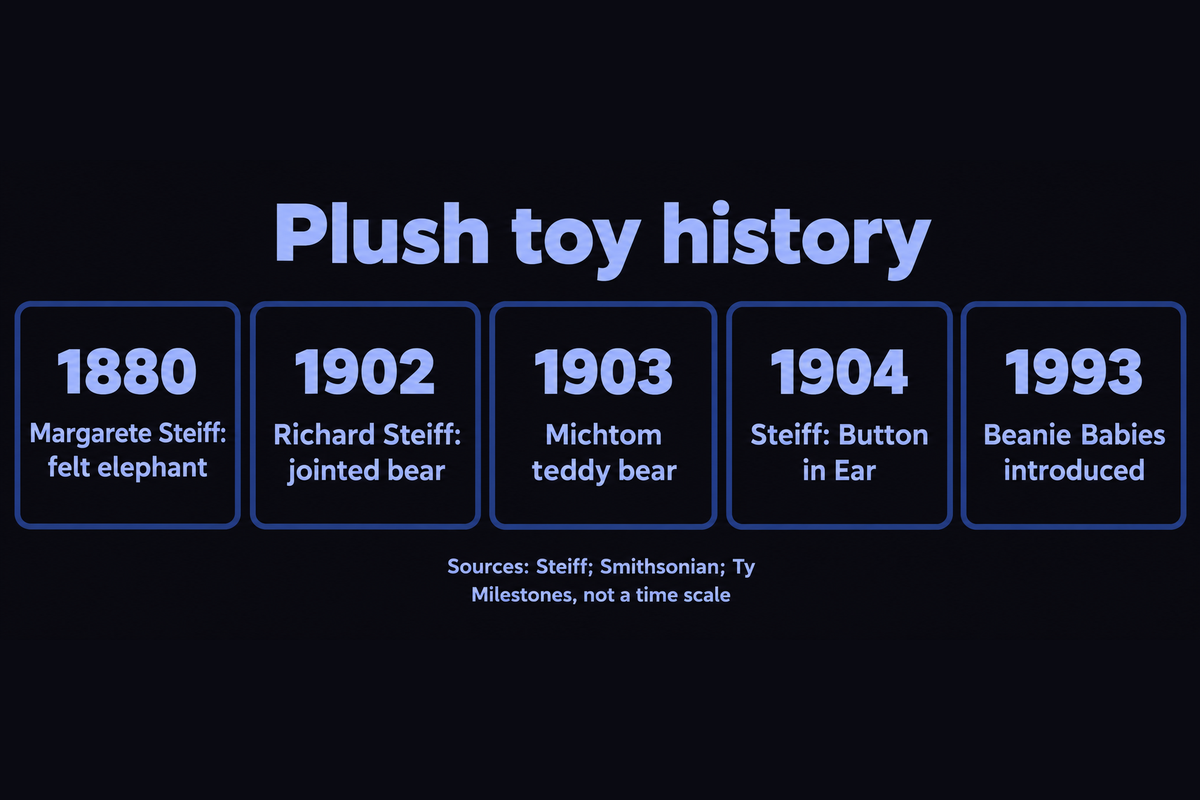
Follow the path from Margarete Steiff’s felt elephant to teddy bears and Beanie Babies. Then use the explorer to compare label clues.
A date on a design is not always the date of your toy. Read the history first, then check the whole object.
The historical record
From a pincushion to a collecting hobby
1880: Margarete Steiff’s elephant
Steiff’s company history dates its felt elephant to 1880. Margarete Steiff used a pattern from a fashion journal. She intended the elephant as a pincushion, but children adopted it as a toy. This is a starting point for Steiff’s history, not a claim that nobody made stuffed animals before her.
Source: Steiff, The Steiff Story, 1880 entry; checked 2026.
1902–1903: different teddy bear stories
Steiff dates Richard Steiff’s jointed Bear 55 PB to 1902. In America, a cartoon about Theodore Roosevelt’s 1902 bear hunt inspired Morris and Rose Michtom to make a plush bear. The Smithsonian dates its Michtom bear to 1903. These records describe different objects and events. They do not establish a single birthday for every teddy bear.
Sources: Steiff, The History of the Teddy Bear, 1902 entry; Smithsonian, Teddy Bear fact sheet, 1903 object; checked 2026.
1904: the Button in Ear
Steiff credits Franz Steiff with the 1904 introduction of its ear button. The first design showed an elephant. The company later used the Steiff name. The button helps identify the maker, but its presence alone cannot identify a production year.
Source: Steiff, The Steiff Story, 1904 entry; checked 2026.
1993: Beanie Babies arrive
Ty dates the introduction of its original Beanie Babies to 1993 at the Gatlinburg Gift Show. Its official account separates that introduction from retail sales in early 1994. The distinction matters when a label or reference book uses a different date.
1903 · Michtom bearThe Smithsonian’s early teddy bear dates to this year. Smithsonian fact sheet.
1904 · Ear buttonFranz Steiff introduces the mark. Steiff history.
1993 · Beanie BabiesTy introduces the original range. Ty catalogue FAQ.
1995 · Website on tagsTy adds its website to heart-shaped hang tags. Ty, Fun Facts, 2025.
Tag-era helper
This helper suggests a broad era, not an exact date or authentication. Select “unknown” when a feature is unclear.
Method: the helper uses the earliest documented milestone for the selected label family. A material choice adds context, not a date. Missing labels supply no date limit. Source dates appear in each result.
1880, 1902, 1903, 1904 and 1993: milestones from Steiff, Smithsonian and Ty records. Cards do not represent a time scale.
Read the whole object
How to use labels and tags
A hang tag hangs from the toy; a sewn label forms part of its construction. Record both before you compare dates.
Copy the maker’s name, model name, item number and all printed dates.
Photograph the front and back of each label, plus the button and seams.
Compare the complete combination with the maker’s catalogue or a museum record.
Keep the design date separate from the production date in your notes.
Ty’s July 2025 article dates the addition of ty.com to its heart-shaped hang tags to 1995. A matching original tag therefore suggests 1995 or later. It does not identify one year. The heart shape alone is weaker evidence because Ty still uses it.
Steiff’s tag guide describes yellow tags for its Friends range. Tag colour identifies a product category in that guide, not a precise historical period. Do not assign an old date from yellow paper alone.
Materials also need context. Steiff describes its Dolly replica as a 2021 release based on a 1913 bear. It uses mohair and wood-shaving filling. Thus, old-looking materials do not prove an old production date. Check for the word “replica” before you treat a historical year as the toy’s age.
Sources: Ty, 5 Fun Facts About Beanie Babies, 2025; Steiff, Button in Ear Tags, checked 2026; Steiff, Dolly bear replica 1913, 2021 release.